Friday, August 6, 2010

Chocolate Peanut Butter Cupcakes

Glen, my husband, loves Reeseʻs Peanut Butter Cups. Always have. Always will. I am not a big fan but because he loves them, I love them. So when I saw this post by Joy the Baker I jumped on it! Too bad I jumped on it when it was away on a trip. It's all in the timing I suppose.

Turns out the recipe for the cupcakes is vegan. Not a one single egg. No sirree. Not for this one. A good dose of canola oil apparently did the moist trick. Super easy to make and like the recipe said, it seems a bit runny, but it bakes up nicely. I used the full 24 minutes in the oven. Just an fyi.

And I used my nifty tupperware piping fancy swirly thing to put on the frosting. I just happen to love the look. But you don't need to. Heck, after you place the reese's peanut butter cup pieces on it, no one really cares how the frosting is put on. It is that good. I found myself eating it without the cupcake. On numerous occasions. I think I need more right now.

I took a dozen cupcakes to work. And comments were very positive. I suspect that maybe they just want to assure a continuous stream of goodies on Aloha Friday but I'm not sure. One office staff member (a male whose name shall remain anonymous, insisted that it was the best ever. And the look of amazement on his face as I told him that I received 7s and 8s from other staff members was almost laughable. . He swears it's a 10 in his book. I think he also considers himself somewhat of a connoisseur. Yay me.


Click here for the recipe.

The recipe made a nice bunch of 24 cupcakes. My friends were surprised that vegan cupcakes could be so moist and delicious! Too bad the frosting isn't vegan. Or maybe not. Anything that's delicious is good for me, vegan or not.

Friday, July 16, 2010

You Can Do It Yogurt

Seriously. You can do it. I didn't give this post this title if I didn't mean it. Seriously. Do you like yogurt? Do your children/toddlers eat yogurt? Do you find the high price of baby yogurt too pricey? Do you love Greek style yogurt but suffer from its sticker shock? My. Oh my. Do you have a crockpot? Say no more. Go now to the store. Buy milk. And a small plain yogurt with live culture in it (check the ingredients). Okay good. Let's get started.
I was obsessed last year with a crockpot website. Stephanie O'Dea, in true Julie Julia style, decided to create a dish a day, all in her crockpot. It didn't matter what it was...drink, dip, dessert, main meal. One a day. And gluten free on top of that! She ended up publishing a cookbook last year and i bought it on amazon.com
Perusing the website, I found a recipe for yogurt and shared it with Kala'i, my daughter, who proceeded to make it right away so she could have yogurt readily available for our little Hulali who absolutely LOVES yogurt. With a little fruit mixed in. Yum. Well since Kala'i was making it, I didn't have to. Until now. I guess being in a cheese making class put me in a dairy state of mind.
So I went back to crockpot365.blogspot.com and looked for the recipe, read all the comments and proceeded w/ no caution. Click on the link to get the directions. What follows here are my comments and the little quirks and lessons learned.
 I used whole milk. I bought a gallon of it at Walmart for about $4.50. You can use lowfat. I don't think I would use nonfat milk for this. Why bother? If you're going to eat yogurt, your main concern is portion control :-) Just make sure it is not ultra pasteurized. That won't work at all. I also bought one container of plain yogurt, probably the cheapest one there at Walmart. I read the ingredients and it just happened to say, much to my delight, that it contained active cultures. You need that because the active cultures is what helps produce a new batch of yogurt (and when this first batch is done you can reserve some of your new homemade yogurt to start up a brand new batch!). Just what I was looking for. Just don't buy vanilla or other flavored/fruit yogurts. You are going to add your own flavorings later. That's really all you need to get started.
Stephanie (crockpot365) used a 4 quart crockpot. Mine is a 6 qt I think. I use what I have.
I started in the early evening, around 5:30 pm which meant that I would have to stay up until 11 pm. That is way past my bedtime but I wanted it done.
The website used a half gallon but I bought a gallon (ambitious). It also called for 1/2 cup of live/active culture plain yogurt and I had a 6 oz. container (I figured 6 oz = 1/2 cup). So I improvised. In the crockpot I poured in about 3/4 of the gallon and let it heat up on low for 2 1/2 hours. Then I unplugged it (being sure NOT to open the lid) for 3 hours. After that, I dumped out the yogurt into a medium bowl, I used the yogurt container to scoop out two containers full of milk from the crockpot into a bowl and I mixed it all together with a whisk. Then I whisked all of THAT into the crockpot. And then I covered it with a towel and then a blanket. The website says to just use a towel but since our house is cold I wanted it to have extra warmth.
Eight hours later, in the morning I unwrapped my present and was presented with a beautiful white yogurt. If the color looks anything different blame it on my rudimentary photography skills.
I scooped some into a bowl, added some honey and granola and had my first bowl of warm wholesome homemade yogurt.
Now for thickening. I wanted to be able to relish the taste of a more "greek style" yogurt. Nice and thick. And then to also use it as a substitute for sour cream. Thus the thickening process. I lined a colander with cheesecloth but you could easily use paper towels or coffee filters. I set the colander in a big bowl (my giant stainless steele salad mixing bowl). I poured in all the yogurt, covered it, and set it in the fridge all day since I would be gone for the day. On the Crockpot 365 website some commenters said that they used lowfat milk/nonfat and then used unflavored gelatin to thicken the yogurt. I didn't want to go there. The less ingredients the better. This draining way seemed way more "natural". And worked fabulously well.
When I came home I couldn't believe how thick it turned out. I had at least two pints of liquid in the bottom of the bowl. And the yogurt was literally ice cream scoopable. 
You might be a bit disappointed that out of an almost full gallon of milk you don't get nearly as much yogurt but it will truly be worth the effort. This is all of it.
From here (or straight from the crockpot) you can add your own honey, vanilla flavoring, fresh fruit, jams or fruit preserves. And if you do go on this yogurt making adventure, please take a moment to blog your experience. Good or bad.
Good luck, my friends. I look forward to hearing from you!

Monday, July 12, 2010

Who Made the Cheese?


I live for cheese. I will never give it up. Even if I become lactose intolerant (which I highly doubt I ever will given my Scandinavian ancestry) I will still eat it in excessive amounts, if possible. So, given my culinary tendencies in the kitchen I jumped at the chance to learn how to make my own cheese when I saw an advertisement for a cheese making class in Waimea. The registration fee was a bit steep ($130 I believe) but I figure this opportunity does not present itself too often here in our state. Apparently cheese making is all the rage on the continent but here there are a few goat dairies and chevre producers and that's about it.
Here is our instructor, Vicki. She hails from Virginia where she was an active cheese maker and writer of all things cheese. She jumped at the chance to intern for a bit at a goat dairy in Ahualoa a few years ago and decided to stay. She is VERY knowledgeable in all things cheesy and dairy related. 

Two of the attendees raise their own goats and sheep for milk (and food, too, I'm sure). And they were nice enough to bring some sheep and goat milk for our cheese production. You can't see it here but the cream content in this sheep milk was very very high. And very white!

Different cheese containers. 
You cannot purchase raw milk of any sort in the state of Hawai'i. Milk HAS to be pasteurized. And probably homogenized. We had raw milk and so we made sure the pasteurize it by bringing it up to a temperature of 145 degrees and keeping it there for 30 minutes. I feel so "in the know" about that now. 
This is my mom. Also a lover of all cheeses. Except for goat or sheep cheese. HAHA! Okay. Here is what I know and retained about cheese making. It's hard. It's complicated. You need meticulous notes and cultures that keep in the freezer. My mom is literally CUTTING THE CHEESE. Yup. Mom's cutting the cheese. Don't ask me why it has to be done. Vicki kind of lost me when she started busting out her different packaged cultures from the freezer. I'm just going to buy the book and start with something REALLY easy that doesn't need brining or sitting. She said something about the beauty of cheese mites and I shut down. I'll just watch and appreciate the hard work and know how of cheese makers. Seriously. But don't be surprised if I start posting some cheese making posts in the distant future. You never know. I ordered the cheese making book on Amazon today.

cheese curds

Beautiful feta made out of sheeps milk
Mom transferring the curds to the mold
Pouring out the whey and cheese curds into a colander
This container was filled to overflowing and then pressed down. It was left to drain, turned over to drain more and so on and so on until it was ready for us to cut and take home.


Here's my feta, crumbled over our tomatoes. You know this is a hit in my house. I mean, what can be better than tomatoes and cheese? Two of my favorites!

Okay, I did make my own cheese already :-)
I took home three pints of whey (the liquid byproduct of cheese making). Put it into a pot and brought it up to 200 degrees. Then I added about a tsp of salt and a tsp of white vinegar and turned the heat off. Voila - RICOTTA!
I think I could make a habit of this cheese making stuff.

More Tomatoes!


I just wanted to share with you more tomato joys. Here are some pictures of my own renegade tomato plant that is growing next to my compost bin in the yard! And more tomatoes purchased from a nearby tomato farm means more roasted tomatoes! We ate some last night, chopped and added to pasta and some just plopped up on slices of bread, with some garlic butter.
Hulali was my official tomato picker, first crop of the season. I have not had great success growing tomatoes way up here in the mountain (too wet, I think) but apparently this warm summer weather and strong wild tomatoes love it!


Glen put up some hog wire so we could tie up the plant to grow up rather than OUT.
Hulali loves showing off tomatoes but hates eating them!

I roasted these cut tomatoes at 250 degrees for about 6 hours.

They look just about done.

The smell in the house is incredible. Once I took the tomatoes out I could just pinch off the skin. I threw them into a tupperware container and drizzled some olive oil over them. The taste is so rich and delicious. I hope you try it. And if you do, I hope you let me know how you like it.

Tuesday, June 22, 2010

Coconut Taro Bread Pudding by Kaulana Dameg


So happy to have my first guest blogger! Kaulana has been a student (KS Middle School boarder), colleague (Hawaiian language/Hale Kuamo'o) and friend for many years. She is also a fellow foodie and baker extraordinaire! She and I drool over each other's food pics on Facebook, mostly on desserts. Oh, do we love to bake and eat. Kaulana's latest concoction, made special for her husband on Father's Day, is a wonderful coconut taro bread pudding, Hilo style. 
Here she is. Isn't she beautiful? Always has been. Inside and out. Here is her post:

Low's International Foods is a restaurant in Hilo that's popular for its many different flavored breads. 

There's taro (most popular), cinnamon, rainbow, ʻulu, coconut, pumpkin, guava, mango, lilikoʻi, banana, and just plain 'ole sweet. Low's breads are always pillowy soft and have a great mild flavor, not too sweet. 


For Father's day, I decided to make bread pudding using their taro and coconut bread. The coconut bread had little bits of coconut baked into it, so instead of mixing additional coconut into the dessert, I just sprinkled some on top. Btw, because you sprinkle the coconut on the dessert midway through baking, it comes out perfectly toasted and makes the whole house smell heavenly. This recipe is based on a coconut bread pudding recipe I found on my favorite recipe website: Allrecipes.com

The verdict: Delicioso! My husband thought it was perfect the way it was, I would have liked to have an accompanying sauce, like creme anglaise or even fresh whipped cream. We paired it with Roselani's haupia ice cream, that was also a good match. I bet this recipe would work with many different flavors of bread, it would be fun to experiment with all the different colors too. Enjoy!

Here's the dessert plated:


Here's the recipe:

Taro Coconut Bread Pudding
butter for greasing the pan
confectioner's sugar for dusting the pan
1 cup white sugar
4 whole eggs + 1 egg yolk, beaten well
1 (14oz.) can coconut milk
1 (14oz.) can regular milk (I used skim)
1 tsp. ground cinnamon
1/4 tsp. ground nutmeg
1/4 tsp. salt
1 Tbsp. + 1/2 tsp. vanilla
1/2 tsp. coconut extract
1 1/2 c. flaked coconut (if using coconut bread from Low's, you'll only need 1/2 c.)
1/2 lb. taro bread, cubed
1/2 lb. coconut bread, cubed

1. Grease a 9x13 inch pyrex baking dish with butter and dust with confectioner's sugar.
2. In a large bowl, beat eggs well, then add all ingredients except flaked coconut and bread cubes. Mix until smooth. 
3. Stir in 1 cup of flaked coconut. 
4. Fold in bread cubes until evenly coated.
5. Pour into prepared baking dish and set aside while preheating oven.
6. Preheat oven to 325°F (165°C).
7. When oven is ready, put dish in the oven on the middle rack and bake for 30 minutes. 
8. Sprinkle top with remaining 1/2 c. flaked coconut then return to oven and bake for an additional 25 to 30 minutes or until center springs back when lightly tapped.
9. Remove from oven and let cool slightly before eating.

Tuesday, June 8, 2010

Honey

There have been so many things I have learned since moving to the big island almost 18 years ago. Random Things. Like the difference between a heifer, cow, steer, and bull (reproduction is the key). And when lehua trees bloom, how protea grows, what mountain oysters taste like (yummy goodness, that's what). I also have seen the cycle of life. Creatures being born, namely, calves, kids (as in goats), foals, puppies and kitties (but I did see a lot of those last two on O'ahu). I have been to 4H auctions, watched a horse being inseminated, witnessed a uterus being massaged with sugar and stuffed back into the cow.  I have played in snow, and gone to the beach. Almost on the same day.
Today is another day. Today Kaipo and I extracted lehua honey. From honeycombs. At a neighbor's house. Yes, it's true. And lehua is in full bloom right now and my neighbor can tell that it is honey made from bees who are feasting on lehua nectar. How cool is that?
My friend, Kepola, has been a beekeeper for the last few years and she invited me over today to help her extract honey. WOW! That's all I got to say.
Here's a honeycomb. It's a wooden structure and beneath all that white (white caps made with beeswax) lies yummy delicious honey. All bee made. Incredible. She had SEVERAL. And they were heavy. Heavy with delicious lehua honey.


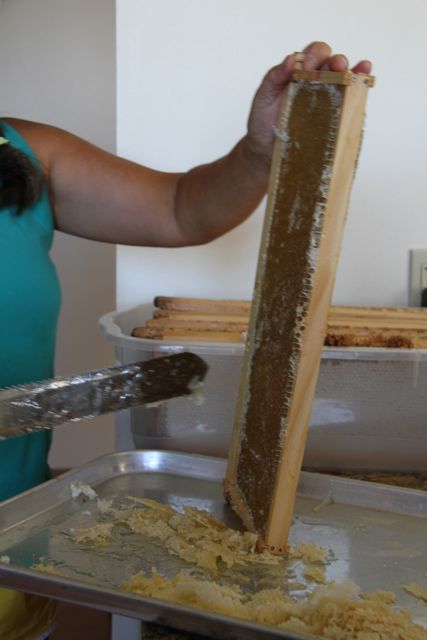
There's a special knife you use to cut off the caps of each cell. It's a skill. When I tried, it was obvious that I was cutting a bit too deep. Wasting honey. The point is to uncap the combs so that you can extract the honey. Just kinda like shave off the caps. 


Sorta like this.


Ta-da!


This one is completely uncapped (both sides. By yours truly). See all the beeswax on the side? I'm gonna melt it all down to extract the honey stuck to it and then figure out what to do with the wax.


Good view of the very long and very sharp serrated like uncapping knife.


Then you place two uncapped combs into an extractor like this one. Hand cranked. Not fun. Invest in an electric one if you can. This one had issues. We are hoping Mr. Honda can fix the issues for the next extraction in July.


This really doesn't depict the incredible speed with which I am spinning this crank. It is NOT fun. And the extractor is trying to move all over the place. My foot is on its foot trying to hold it in place. Did I say it was hard?


Inspecting the combs following the spinning, making sure that most of the honey has been spun out of it (it's all about centrifugal force). If I spun it, it probably has to go in again for additional spinning. I tell you, it's a skill!


All those caps. Mixed with honey. I had to scoop some up and try it. It's kind of like chewing gum. When you first get it in your mouth and give the first few chews all the flavor seeps out. And then you're left with flavorless chew. But with this you're left with wax. And a wonderful honey goodness in your tummy.


The honey exists through a spout on the bottom of the extractor that has a very high tech device to catch any residue. It is called "women's pantyhose". 
Thanks, Kepola. It was GREAT GREAT FUN! And we want to do it again. I'll even crank that damn extractor again.


Oh, and we found a turkey egg in the driveway. Yay. Breakfast tomorrow.

SLOW FOOD FRIDAY

S L O W   F O O D    F R I D A Y Wow. Has it been that long? Don't think I fell off the face of the earth due to my increased weig...